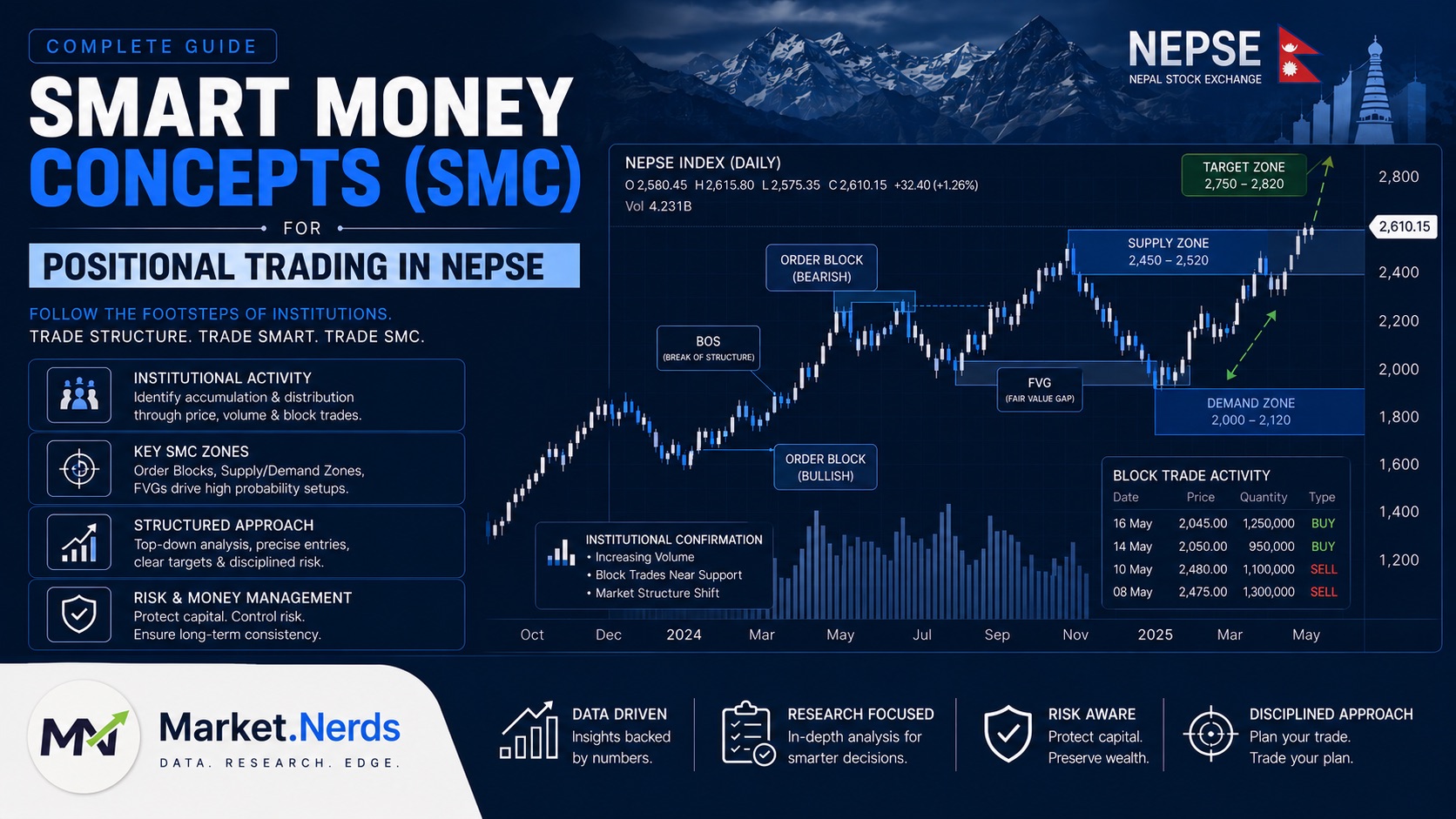
Smart Money Concepts (SMC) Positional Trading in NEPSE
By Market.Nerds
Introduction
The Nepal Stock Exchange (NEPSE) presents a unique environment for traders seeking to apply Smart Money Concepts (SMC). Compared to larger global markets, NEPSE's relatively smaller size and lower liquidity often make institutional activity more visible on price charts. This transparency creates opportunities for traders to identify accumulation, distribution, supply, and demand zones with greater clarity.
Positional trading, which involves holding positions for several weeks to a few months, aligns particularly well with the structure of the Nepali market. Rather than focusing on short-term price fluctuations, positional traders seek to capitalize on broader market movements driven by institutional participation and sector rotation.
This guide outlines a practical framework for applying Smart Money Concepts within NEPSE, helping traders identify high-probability opportunities while maintaining disciplined risk management.
Why Smart Money Concepts Work in NEPSE
Market Structure Advantages
NEPSE possesses several characteristics that make Smart Money Concepts especially effective:
Visible Institutional Activity
Large institutional transactions often leave clear footprints in price action. Unlike highly liquid global markets, where significant orders can be absorbed with minimal impact, institutional buying and selling in NEPSE frequently produce noticeable price movements and volume spikes.
Clearly Defined Supply and Demand Zones
Due to relatively lower market participation, support and resistance levels tend to be respected more consistently. This makes the identification of supply and demand zones more straightforward for traders utilizing SMC principles.
Block Trade Transparency
NEPSE's publication of block trade data provides valuable insight into institutional positioning. By monitoring recurring transaction levels and volume concentrations, traders can identify areas where large market participants have shown significant interest.
Retail-Dominated Market Dynamics
A substantial portion of NEPSE trading activity is driven by retail investors. This often results in emotionally driven market behavior, creating opportunities for informed traders to identify periods of institutional accumulation during fear and distribution during excessive optimism.
Understanding Positional Trading
Positional trading involves capturing medium-term market moves by aligning with institutional capital flows. Typical holding periods range from two to eight weeks, depending on market conditions and the strength of the underlying trend.
Core Components
Entry
Identify signs of institutional accumulation near key demand zones.
Look for volume confirmation and supportive price action.
Holding Period
Allow sufficient time for the market structure to develop and for institutional positioning to influence price movement.
Exit
Target previously identified supply zones or signs of institutional distribution.
Risk Management
Maintain predefined stop-loss levels and appropriate position sizing to protect trading capital.
The objective is not to predict every market movement but to participate in high-probability opportunities where risk-reward dynamics are favorable.
Identifying Key SMC Zones in NEPSE
1. Order Blocks
Order blocks represent areas where significant institutional buying or selling activity occurred before a strong directional move.
Key characteristics include:
Large impulsive candles
Significant volume expansion
Strong continuation following the move
These areas often act as future support or resistance when revisited by price.
2. Supply and Demand Zones
Supply and demand zones represent areas where market participants have historically demonstrated substantial buying or selling interest.
When evaluating these zones, traders should consider:
Historical reaction points
Volume concentration
Block trade activity
Market structure alignment
3. Fair Value Gaps (FVGs)
Fair Value Gaps occur when price moves aggressively, creating an imbalance between buyers and sellers.
In NEPSE, these gaps often attract future price action as the market seeks to rebalance inefficiencies. Traders can use these areas as potential entry, exit, or confirmation zones within a broader trading framework.
The NEPSE SMC Positional Trading Framework
Step 1: Analyze Sector Strength
Begin with a top-down approach by evaluating sector performance on higher timeframes.
Questions to consider:
Which sectors are demonstrating relative strength?
Where is institutional capital flowing?
Which sectors are outperforming the broader market?
Strong sectors often provide the highest-probability trading opportunities.
Step 2: Identify Accumulation
Focus on stocks showing evidence of institutional accumulation:
Price returning to a demand zone
Increasing volume near support
Bullish rejection candles
Positive market structure shifts
Block trade activity near key levels
The convergence of multiple factors significantly improves trade quality.
Step 3: Define the Target Zone
Before entering a trade, identify logical distribution zones or resistance levels where institutional selling may emerge.
This establishes:
Profit objectives
Risk-reward ratios
Trade management expectations
Step 4: Execute with Discipline
Entry should occur only after confirmation is present.
Best practices include:
Predefined stop-loss placement
Risking no more than 1–2% of total trading capital per position
Maintaining patience during consolidation periods
Avoiding emotional decision-making
Successful positional trading is built on consistency, not frequency.
Using Block Trade Data as an Institutional Indicator
Block trade reports provide valuable insight into market participation by larger investors.
Key observations include:
Bullish Signals
Large purchases occurring near support levels
Repeated block transactions within a defined price range
Volume expansion accompanying accumulation
Bearish Signals
Significant selling activity near resistance
Multiple large transactions at elevated prices
Distribution patterns following extended rallies
By combining block trade analysis with market structure, supply-demand zones, and price action, traders can develop a more complete understanding of institutional behavior within NEPSE.
Final Thoughts
Smart Money Concepts should not be viewed as a predictive tool but as a framework for interpreting market behavior. The goal is to align trading decisions with institutional participation, manage risk effectively, and maintain a structured approach to market analysis.
In a market such as NEPSE, where institutional footprints can often be observed more clearly, disciplined application of SMC principles can provide traders with a meaningful edge over the long term.
DISCLAIMER
This educational guide is intended for informational purposes only and does not constitute financial advice, investment recommendations, or a solicitation to trade financial instruments. Trading involves substantial risk and may not be suitable for all investors. Always conduct independent research and implement proper risk management.