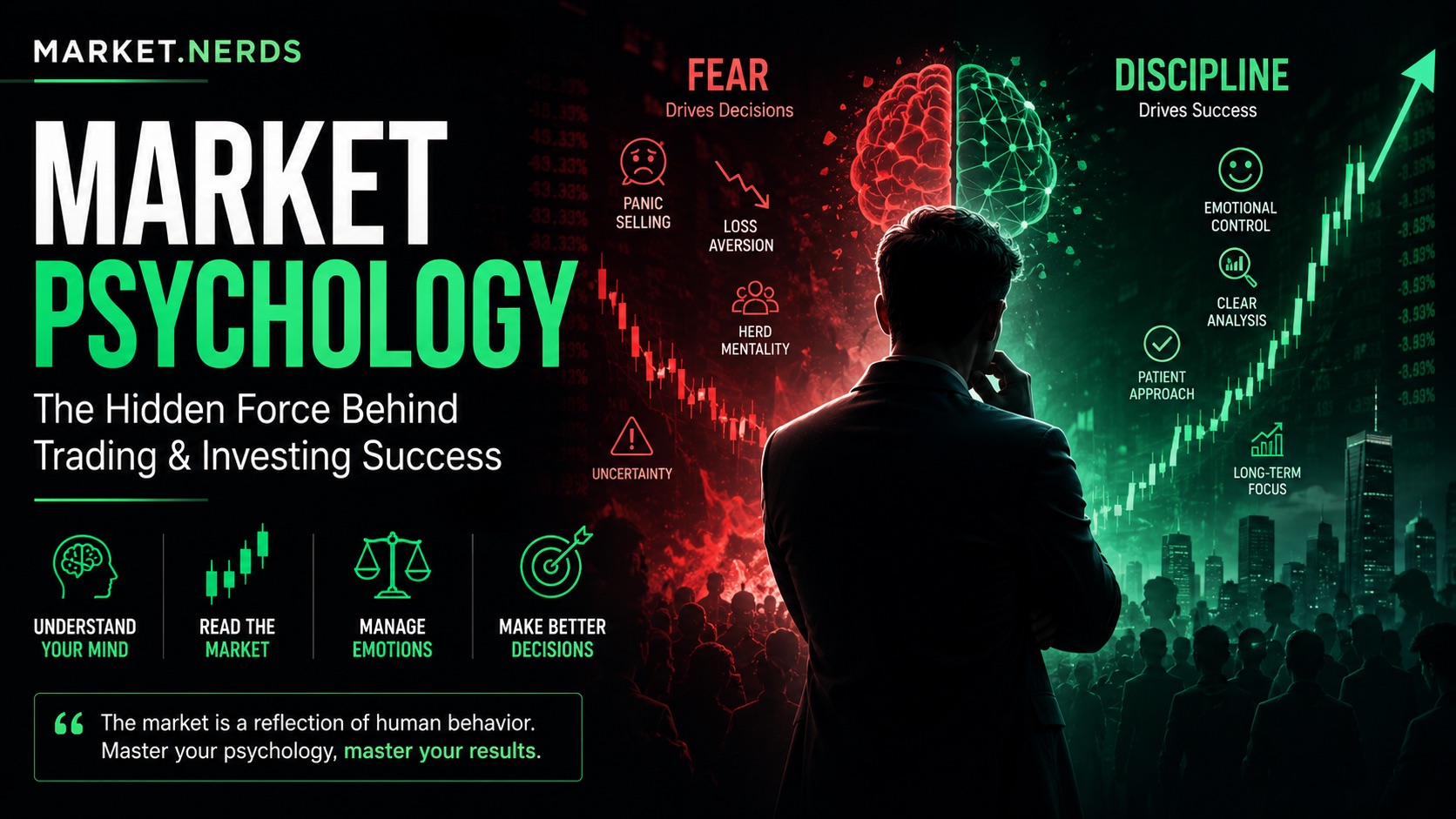
Market Psychology: The Hidden Force Behind Trading and Investing Success
Financial markets are often perceived as systems driven by data, earnings, economic reports, and technical indicators. While these factors certainly matter, one of the most powerful forces influencing price movement is often overlooked: human psychology.
Market psychology refers to the collective emotions, beliefs, and behaviors of market participants. Fear, greed, optimism, uncertainty, and herd behavior influence investment decisions every day, shaping trends, volatility, and market cycles across stocks, forex, commodities, cryptocurrencies, and emerging markets such as NEPSE.
Why Market Psychology Matters
Successful investing is not solely about identifying the right opportunities—it is also about managing emotions and understanding how other market participants react under different conditions.
Many investors buy assets when prices have already risen significantly because they fear missing out on potential gains. Conversely, they often sell during periods of panic when prices have fallen sharply. These emotional decisions can lead to poor long-term results.
Professional traders understand that markets are driven by human behavior. Rather than reacting emotionally, they seek to identify emotional extremes and position themselves accordingly.
The Core Emotions Driving Markets
Fear
Fear is one of the strongest forces in financial markets. During periods of uncertainty, investors rush to protect capital, often leading to sharp declines and increased volatility.
Fear-driven selling can create opportunities for disciplined investors who recognize when market reactions become excessive.
Greed
Greed emerges when markets experience sustained upward momentum. As prices rise, investors become increasingly optimistic and are often willing to take greater risks.
This behavior can push valuations beyond reasonable levels and contribute to speculative bubbles.
Hope and Denial
Many investors hold losing positions because they hope prices will recover. Instead of objectively evaluating market conditions, they remain emotionally attached to their investments.
This tendency often prevents timely risk management and can magnify losses.
FOMO (Fear of Missing Out)
FOMO is particularly common during strong bull markets. Investors enter positions late, driven by social media narratives, headlines, and the success stories of others.
When enthusiasm reaches extreme levels, markets often become vulnerable to sharp corrections.
Understanding Herd Mentality
Humans naturally seek validation from groups, and financial markets are no exception. Investors frequently follow the crowd, believing that widespread participation confirms the correctness of a decision.
However, history shows that the majority is often most optimistic near market tops and most fearful near market bottoms.
The ability to think independently is one of the defining characteristics of consistently successful investors.
Market Cycles and Investor Psychology
Every major market cycle follows a recognizable psychological pattern:
Optimism – Confidence begins to improve as markets recover.
Excitement – Positive sentiment attracts additional participants.
Euphoria – Excessive confidence drives aggressive risk-taking.
Anxiety – Early signs of weakness appear.
Fear – Selling pressure accelerates.
Panic – Emotional decisions dominate market behavior.
Capitulation – Investors abandon positions at significant losses.
Recovery – Confidence gradually returns and a new cycle begins.
Understanding these stages helps investors identify where the market may be positioned within a broader cycle.
Psychology Across Different Markets
Stock Markets
Investor sentiment plays a major role in equity valuation. Corporate earnings, economic expectations, and central bank policy often influence market psychology more than the underlying numbers themselves.
Forex Markets
Currency markets are heavily driven by expectations and sentiment. Central bank announcements, interest rate decisions, and geopolitical developments can trigger rapid shifts in trader behavior.
Cryptocurrency Markets
Crypto markets frequently exhibit heightened emotional extremes. Rapid rallies and corrections often reflect speculative enthusiasm and fear rather than fundamental value.
Emerging Markets
Markets such as NEPSE can experience stronger psychological swings due to lower liquidity, concentrated participation, and heightened sensitivity to local news and investor sentiment.
The Contrarian Advantage
Many of the world's most successful investors share a common principle: they avoid following the crowd.
Contrarian investors seek opportunities when fear dominates and exercise caution when optimism becomes excessive. Their goal is not to oppose the market blindly, but to recognize situations where emotion has created pricing inefficiencies.
In simple terms:
Buy when quality assets are undervalued due to excessive fear.
Reduce exposure when irrational optimism drives unsustainable valuations.
Focus on facts rather than emotions.
Developing Psychological Discipline
Improving investment performance often requires mastering personal behavior rather than discovering a new indicator or strategy.
Key practices include:
Following a clearly defined investment plan.
Maintaining disciplined risk management.
Avoiding impulsive decisions based on headlines.
Keeping emotions separate from analysis.
Reviewing mistakes objectively and learning from them.
The most successful investors understand that controlling their own psychology is often a greater advantage than predicting market direction.
Final Thoughts
Market psychology is one of the most powerful yet underestimated drivers of financial markets. Every price movement reflects the decisions, emotions, and expectations of millions of participants.
Technical analysis, fundamental research, and economic data remain important, but their effectiveness is limited if investors cannot manage their own emotional responses.
The greatest edge in investing is not superior information—it is superior discipline. Those who understand market psychology and maintain emotional control are better positioned to navigate uncertainty, identify opportunities, and achieve long-term success.
At Market.Nerds, we believe that understanding human behavior is just as important as understanding financial markets. The investors who master both gain a sustainable advantage in an increasingly competitive world.